


Georgia remains one of the few European markets where relatively accessible entry pricing still coexists with meaningful rental yield and capital appreciation. According to Geostat, real GDP growth reached 7.5% in 2025, while the country recorded 5.8 million international visitors who made 5.5 million tourist-type visits. High-ROI property is usually created where economic activity, visitor flow, and tenant demand are working together in tandem, so those numbers matter.
The core question is not whether Georgia is a good investment destination in general, but which assets are best positioned to preserve those investments and retain exit liquidity.
Investment Property for Sale in Georgia: Why 2025 Data Still Points towards High ROI
The World Bank’s B-READY 2025 profile shows Georgia scoring 89/100 in Business Entry, placing it in the top 20% globally. Simple electronic business registration and streamlined incorporation procedures are also mentioned as some of the most important strengths for building a business here. In the same profile, Georgia scores 9.2/10 on the absence of restrictions on owning and leasing property, with one glaring limitation relating to agricultural land ownership (which, as a rule, foreign investors have lower interest in anyways) rather than standard urban residential real estate.
The tax system also helps explain why investment property for sale in Georgia continues to attract capital. PwC’s Georgia tax summary notes that in most cases, residential rental income is only subject to a 5% personal income tax. Property tax for resident individuals only becomes a case once annual family income exceeds GEL 40,000. The tax system in Georgia is noticeably more sparing towards property owners than other European countries, which supports a more efficient net-yield profile than many investors would expect from a growth market.
Geostat’s 2025 inbound tourism release reports 5.5 million tourist-type visits and an average stay of 5.6 nights, while 78.4% of visits were repeat visits. That matters because repeat visitation points to demand that is not being driven only by one-off travel spikes.
Real Estate Investment Opportunities Georgia: The Three Filters To Use When Choosing Property
In Georgia, the difference between an average asset and a high-performing one usually comes down to three questions: where is the prospective investment property located, who is building it, and how well the property matches existing rental and resale demand.
Filter #1: Location
The first filter is location. TBC Capital’s August 2025 Tbilisi residential market watch recorded 2,823 transactions, an average asking sale price of US$1,283 per sq.m., an average asking rent of US$10.2 per sq.m., and an average rental yield of 8.4%. Those numbers position real estate investing in Tbilisi as a stable core benchmark for potential investors looking into properties, especially considering a strong reference market for rental property for sale in Georgia.
Filter #2: The Developer
The second filter is the developer behind the choice. Approaching the developer with due diligence can either prime investors for great ROI - or waste their investments. Correct choice determines delivery quality, tenant appeal, and exit liquidity, so it is best treated as a risk-control variable at the same level as the choice of a district. The safer approach is usually to prioritize active developers with visible pipelines, clear specifications, and projects in districts where liquidity can be checked against independent market data.
Filter #3: The Property Itself
The third filter is the positioning of the asset itself. High ROI real estate in Georgia is rarely determined just by the purchase price. It’s largely about the tenant profile a building can attract and the resale audience it can have later. District, transport links, surrounding daily-use infrastructure, building quality, apartment layout efficiency and the amenities all matter because they form an interconnected tight web where all variables affect rentability, vacancy risk, and exit liquidity rather than headline pricing alone.
Buy to Let Georgia: Tbilisi and Batumi Above the Rest of the Market
Tbilisi and Batumi remain the two most important reference markets for investors assessing buy-to-let property in Georgia. But one must keep in mind that they require a different approach when adding to an investment profile. Tbilisi tends to offer stronger year-round rental depth and broader tenant demand. Batumi, on the other hand, is more closely tied to tourism flows and seasonal performance, with ROI highly dependent on correct project selection.
Tbilisi Investment Property for Sale: The Engine of Year-Round Rental Demand
If you want to implement a buy to let in Georgia strategy, Tbilisi definitely has the stronger and cleaner underwriting case compared to the rest of the country. Alongside TBC Capital’s 8.4% rental-yield estimate, Geostat reports that 36.2% of inbound visits in 2025 included Tbilisi, once again reinforcing the city’s role as the country’s primary year-round demand center rather than a purely seasonal destination. That is it’s the primary market when it comes to real estate investment opportunities in Georgia.
Though a deeper dive into the Tbilisi property market analysis through the district-level data from Galt & Taggart’s 2025 year-end review can add a clearer context. There’s a clear distinction in demand, and thus in pricing - and ROI - among the districts. In the primary market, Vake averaged US$2,781 per sq.m., Saburtalo US$1,613, and Krtsanisi US$1,575, while Nadzaladevi averaged US$1,189 and Didi Dighomi US$1,076.
Batumi Investment Property for Sale: Tourism-Led Demand With More Asset Sensitivity
Batumi still belongs in the investment discussion, but the data support a more selective approach. Galt & Taggart’s 2025 review shows 17,478 apartment transactions in 2025, up 15.0% year over year, and market size expanding to US$1.3 billion, up 23.8%. That said, the discrepancy between various districts is far starker here: Batumi real etate for sale with a sea view has several times higher the chance to yield steady ROI than inner-city property, which tends to rise in demand only after the coastline has either been fully occupied or priced out due to high demand during tourist season.
Potential investors need to approach Batumi with more care than Tbilisi. The ROI one can render from this market tends to be less stable across months and depends on tourist influx. Any potential investment is better analyzed through a project-selection market rather than a blanket market. Generally, coastline property with sea view, aparthotels with high service standards and extra amenities, and luxury condominiums tend to perform better (are strongly positioned and marketed). You can learn more about why you should invest in Batumi apartments and how to do it through our deep dive guide.
Tbilisi offers steadier year-round cash-flow logic and broader tenant depth; Batumi offers upside, but with more sensitivity to pipeline pressure and operating model. Investors considering various apartments for investment in Georgia across both cities should pay more attention to the specificities of each market than broad national averages.
Learn About Archi’s Ongoing Projects in Market Context
Archi is most useful here not as proof of the overall market, but as a live example of how ongoing projects can be mapped against district-level data.
Investing in the Archi Projects in Tbilisi: What to Know
In Tbilisi, Archi offers several ongoing projects that are well-positioned to return high ROI with time, specifically due to the interconnected variables aligning with current renter market demands.
One such example is the Archi Grand Avenue project. It’s located on Dadiani Street near Dinamo Stadium, 150 meters from Nadzaladevi Metro, while Archi Rivertown is positioned on Agmashenebeli Alley next to Digomi 8 and Tbilisi Mall. Galt & Taggart’s 2025 district data shows Nadzaladevi at 3,145 apartment sales, an average primary-market price of US$1,189 per sq.m., and average rent of US$9.4 per sq.m.; Didi Dighomi recorded 9,440 apartment sales, an average price of US$1,076, and average rent of US$8.5. These figures do not exactly predict project-level performance, but when researching flats in Tbilisi for sale, they can be an important variable that can help determine the project positioning: if it sits in active districts, if it will have visible demand, if there’s readable pricing, etc.
Archi Rivertown fits more naturally into the premium end of the discussion, while Grand Avenue’s scale and mixed-use character broaden its appeal beyond a standard residential-only screen, Rivertown specifically aims at people interested in luxury apartments for long-term stable residence (and delivering appropriate ROI for potential investors aiming at this specific segment).
Batumi: Archi Ramada Batumi
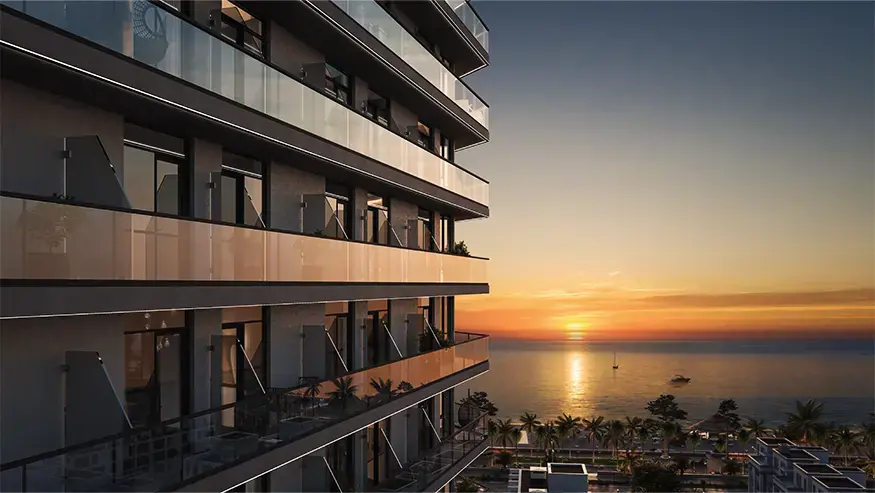
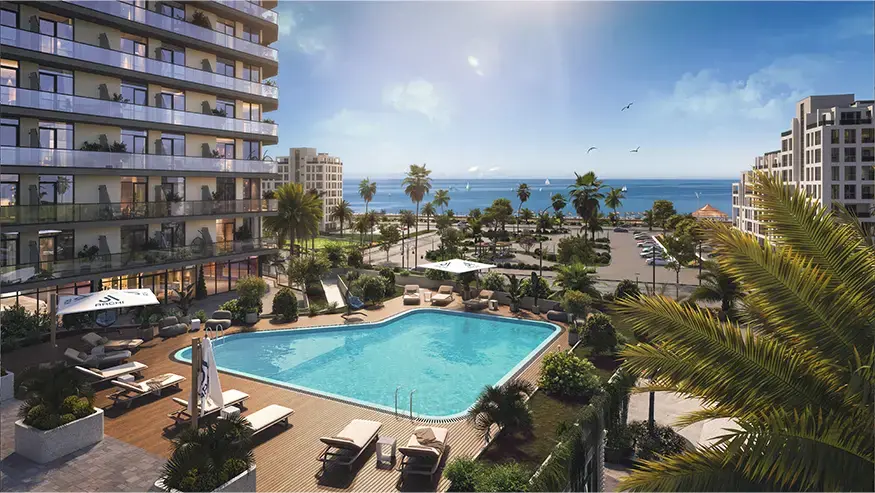
Archi Ramada Batumi is located on Inasaridze Street near the New Boulevard, 150 meters from the beach. Considering current market trends in Batumi, the project ticks all the boxes required to position it as a good investment: it’s a high class construction with a sea view in partnership with international brand, it’s an aparthotel that provides potential residents (and renters) with conveniences of hotel-style services and extra amenities, it’s located in an active district with well-developed infrastructure.
Satisfying those trends is not a guaranteed outperformer maker for any single project, but it does place Archi Ramada Batumi in one of Batumi’s most active coastal submarkets and marks it as a comparatively well-positioned new construction investment in Georgia, even in a more competitive and volatile environment.

How to Secure High-ROI Property in Georgia
The acquisition logic should stay sequential: define the strategy, model gross and net yield, verify title, permit status, and delivery specification, and only then decide whether leverage improves the case.
Approach financing the property in the same way. Mortgage laws in Georgia are simple and even foreign residents can get comparatively easily approved for one at local banks. The National Bank of Georgia’s Q1 2025 Credit Conditions Survey shows mortgage interest rates at around 13.4% for GEL-denominated mortgages, 8.5% for USD mortgages, and 6.9% for euro mortgages. Investors should not eliminate financing as a tool, but make sure leverage improves cash flow rather than dilutes it.
Better yet, currently there’s a trend on the rise: 0% internal installment payment plans that help buyers bypass banks altogether. Internal installment plans allow investors to pay directly to the developer, without added fees to the bank. However, installment plans are individual to the developer, with the schedule and monthly payment amount heavily depending on numerous factors: down payment percentage, construction schedule, etc. Once settled on the project they wish to invest in, the buyer should contact the developer and discuss the payment options in-depth, before settling on the schedule.
The data-led conclusion is consistent. Tbilisi remains the stronger base market for year-round rental income; Batumi is more asset-sensitive, however, it can yield high ROI if the investment property is positioned correctly. There are no new shortcuts one could exploit: the most credible path to high ROI still begins with district quality, yield discipline, and project-level screening. And while Archi’s ongoing projects, such as Archi Grand Avenue, Archi Rivertown, or Archi Ramada Batumi, can be treated as notable shortlist candidates within a larger evidence-based search, their positioning should not be viewed as substitutes for in-depth market search itself.